
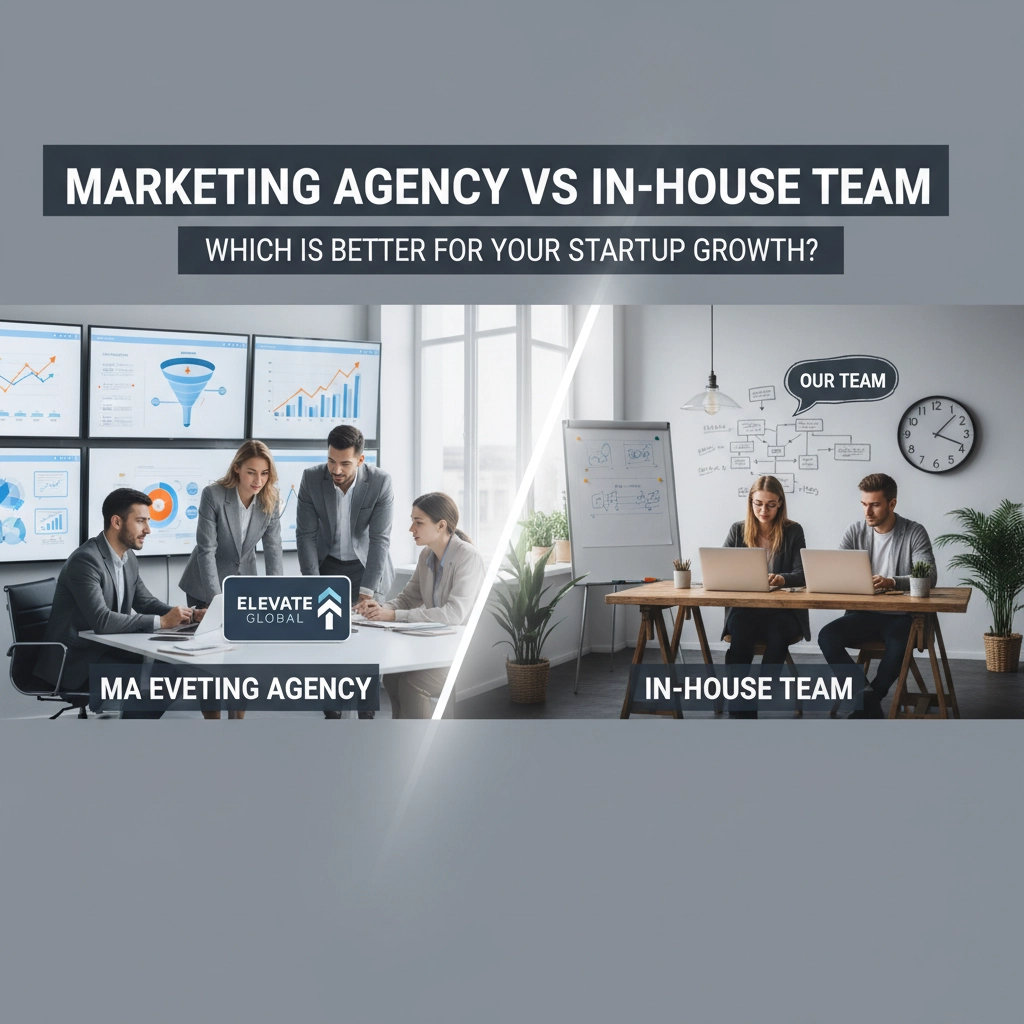
You’re sitting there staring at your startup’s marketing performance, and it’s not moving the needle fast enough. Your competitors are gaining ground while you’re stuck debating whether to hire an in-house marketing team or partner with an agency. This decision isn’t just about budget: it’s about survival in today’s ruthless startup landscape.
Here’s the brutal truth: 90% of startups fail because they can’t effectively reach their target market. The choice between building an internal marketing machine or leveraging external expertise will make or break your growth trajectory. You don’t have time for trial and error, so let’s cut through the noise and figure out what’s going to accelerate your startup’s success.
The In-House Marketing Team Reality Check
As a mentor of mine once told me, “In-house is out-house”. That’s always stuck with me over the years. Building your own marketing team sounds appealing: complete control, deep product knowledge, and no external dependencies. But before you start posting job listings, you need to understand what you’re really signing up for.
The Power of Internal Control
When you build an in-house marketing team, you’re creating a marketing engine that lives and breathes your product. Your team members become embedded in your company culture and develop an intimate understanding of your customer journey that no external partner can match. This deep institutional knowledge translates into more authentic messaging and campaigns that truly resonate with your audience.
The speed advantage is undeniable. Need to pivot your messaging based on customer feedback? Your in-house team can execute changes immediately without coordinating with external stakeholders or waiting for approval processes. This agility becomes crucial when you’re responding to market opportunities or competitor moves in real-time.

The Financial Reality
Here’s where things get expensive, fast. Building a competent in-house marketing team requires significant upfront investment. You’re looking at $250,000 to $500,000 annually for a small but effective team, and that’s before benefits, training, and marketing tools. A single marketing manager averages $85,000 per year, and you’ll need specialists across multiple channels to compete effectively.
The hiring process alone will slow your momentum. The average time to hire for a marketing position is 50 days: time you can’t afford when your runway is burning and competitors are gaining market share. Every day without proper marketing execution is revenue left on the table.
The Expertise Limitation Problem
Unless you’re planning to hire 10+ specialists, your in-house team will have significant skill gaps. You might have a great content creator but lack expertise in paid advertising optimization, conversion rate optimization, or marketing automation. These gaps force you to either accept suboptimal performance or invest even more in additional hires and training.
The Marketing Agency Advantage
Marketing agencies exist to solve one fundamental problem: giving you access to world-class marketing expertise without the overhead of building it yourself. But not all agencies are created equal, and understanding their true value proposition is critical to making the right decision.
Immediate Access to Specialized Expertise
When you partner with a marketing agency, you’re not just hiring one person: you’re gaining access to an entire team of specialists. Research shows that 64% of companies report better access to specialized expertise when working with agencies compared to in-house teams. This means you get experts in paid advertising, SEO, content marketing, analytics, and conversion optimization working on your campaigns from day one.
The tool advantage is significant. Agencies invest in premium marketing technologies and AI-powered analytics platforms that would cost your startup tens of thousands of dollars annually. You immediately benefit from their established processes, proven frameworks, and battle-tested strategies without the learning curve.

Cost-Effective Scalability
Agency retainers typically range from $3,000 to $15,000 per month: a fraction of what you’d spend building an equivalent in-house team. This predictable cost structure allows you to scale marketing investment up or down based on performance and budget without employment obligations or severance costs.
The flexibility advantage cannot be overstated. If a strategy isn’t working or market conditions change, you can pivot quickly without the complications of managing employee transitions. This agility is crucial for startups operating in dynamic markets where adaptability determines survival.
Speed to Market Dominance
Agencies have refined workflows and established vendor relationships that enable rapid campaign launches. While you’re still interviewing candidates for your marketing manager position, an agency can have campaigns running and generating data within weeks. This speed advantage compounds over time, giving you months of additional market presence and customer acquisition.
The Decision Framework That Actually Matters
Stop making this decision based on what sounds good in theory. Your choice should be driven by your specific situation, constraints, and growth objectives. Here’s how to evaluate your options systematically.
Evaluate Your Current Stage and Resources
If you’re pre-Series A with limited runway, the agency route makes financial sense. You need to prove market fit and achieve growth milestones without burning through capital on expensive hires. Agencies provide the expertise you need while preserving cash for product development and customer acquisition.
For post-Series A companies with proven product-market fit, building an in-house team becomes more viable. You have the resources to invest in recruitment and the long-term horizon to realize the benefits of internal team development.

Assess Your Product Complexity
Complex technical products (SaaS platforms, AI solutions, biotech innovations) benefit from in-house teams that can develop deep product expertise. The nuanced understanding required to effectively market sophisticated solutions often requires embedded team members who live with your product daily.
Consumer products or services with straightforward value propositions work well with agency partnerships. Agencies can quickly understand your offering and leverage their experience with similar products to accelerate growth.
Consider Your Control Requirements
If your startup operates in a highly regulated industry or requires immediate response to market changes, in-house teams provide the control and responsiveness you need. The ability to make real-time adjustments without external coordination can be a competitive advantage.
However, if you value strategic guidance and fresh perspectives over direct control, agencies bring outside insights that can identify blind spots and opportunities your internal team might miss.
The Hybrid Approach: Best of Both Worlds
Smart startups don’t limit themselves to binary choices. The most effective marketing operations often combine internal strategic oversight with external specialized execution.
Consider hiring a strong marketing leader internally to own strategy, brand positioning, and cross-functional coordination while outsourcing specialized tactics like paid advertising, SEO, and marketing automation to agencies. This approach gives you internal control over messaging and strategy while leveraging external expertise for technical execution.
This hybrid model becomes particularly powerful as you scale. Your internal leader understands your business deeply and can effectively manage agency relationships while the agencies provide specialized skills and execution capacity.

Making the Decision That Accelerates Growth
Your marketing approach should accelerate growth, not create operational complexity. If you’re spending more time managing marketing operations than focusing on product and sales, you’ve chosen poorly.
For most early-stage startups, agencies provide the fastest path to professional marketing execution. You get immediate access to proven strategies, established processes, and specialized expertise without the recruitment delays and operational overhead.
As you scale and achieve predictable revenue, transitioning to in-house teams or hybrid approaches makes sense. But in the early stages, speed and efficiency trump theoretical control advantages.
The startups that win aren’t necessarily those with the most control: they’re the ones that execute fastest and most effectively. Choose the approach that gets you to market dominance before your competitors figure out what you’re doing.
Your startup’s future depends on marketing execution, not marketing org charts. Make the choice that accelerates growth, proves product-market fit, and positions you for long-term success. The clock is ticking, and your competitors aren’t waiting for you to build the perfect marketing organization.
Ready to accelerate your startup’s growth with expert marketing execution? Contact OC3 Group to discuss how our proven strategies can drive your success without the overhead of building an internal team.